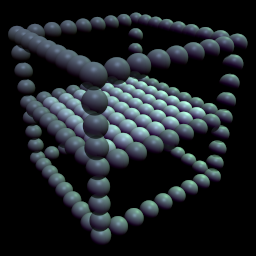
Recent REM Framework simulations measured how consistently a wave pulse reaches receivers placed at equal Euclidean radii in an experimental diamond lattice. In a 240³ run, fifteen of sixteen tested radii showed less than 1% relative spread in interpolated half-peak arrival time. The measurements show a promising long-wavelength trend, while other diagnostics still show directional differences.
Purpose of the experiment
The REM Framework investigates whether physical behavior can emerge from local interactions between neighboring nodes. Earlier cubic-lattice measurements showed direction-dependent propagation. The recent diamond-lattice study asks whether a different local connectivity can reduce that directional variation in a controlled measurement.
This is an experimental comparison within the simulator. The diamond topology is not the canonical cubic Node 0.1 foundation, and the results do not establish that REM Framework describes physical reality.
How the measurement was made
The completed v0.5.0 arrival-timing run used a 240 × 240 × 240 experimental diamond lattice with absorption disabled. It tested 26 excitation orientations. For each orientation, 16 receiver rays were placed in a plane perpendicular to the excitation direction. Receivers were sampled on 16 equal-radius shells, from 40 through 85 bond lengths in steps of three.
At each receiver, arrival was defined as the linearly interpolated first crossing of 50% of that receiver’s own absolute peak. This receiver-relative threshold makes the timing comparison less dependent on amplitude, but it does not measure amplitude equality or directly calculate a directional speed.
All 256 receiver pulses in each orientation were recorded as complete at update 272, before the conservative graph-based boundary-safe limit of update 319. Each shell therefore contains 416 measurements: 16 rays across 26 orientations.
Arrival-time results
Fifteen of the sixteen tested radii—43 through 85 bond lengths—had a relative half-peak arrival-time spread below 1%. At radius 40, the spread was 1.059680%, just above that threshold. The measurements therefore support a bounded statement about most tested shells, not a claim that every shell was below 1%.
Across the tested range, relative spread decreased overall from 1.059680% at radius 40 to 0.259886% at radius 85. A linear fit gives a slope of −0.015688 percentage points per bond, with R² = 0.941157. The trend is not strictly monotonic from one shell to the next. The absolute range of arrival times also generally decreased, from 0.938161 to 0.508060 simulation updates.
Mean half-peak arrival increased nearly linearly with radius in this configuration: t = −6.703147 + 2.376603r, with R² = 0.999992. The corresponding slope-equivalent value is 0.420769 bonds per update. This is a fit to this experiment, not a universal propagation constant.
Timing does not tell the whole story
Receivers can cross their own half-peak thresholds at similar updates while recording different peak amplitudes. In the same 240³ survey, pooled peak-amplitude spread remained between 8.98% and 18.40% across the tested shells. A separate 120³ absorption-off experiment at radius 42 recorded 0.858572% arrival spread and 18.627066% peak-amplitude spread.
A measurement audit also found that probe interpolation can smooth a synthetic radial signal: the interpolated signal showed an 8.608966% peak spread, while raw nodes at one exactly shared radius differed by 9.681651%. These are different populations and should not be added together. Interpolation effects and finite-scale directional response remain separate questions for investigation; the integrator was not changed to normalize away amplitude differences.
An adjacent-shell correlation-speed statistic also retained approximately 1.25–2.20% spread. It is an independent diagnostic and should not be conflated with the half-peak arrival-time spread.
What can be concluded
Under the stated long-wavelength conditions, this controlled diamond-lattice run produced sub-1% relative half-peak arrival-time spread at 15 of 16 radii, with an overall decrease in spread as receiver distance increased. This is evidence of improved arrival-time agreement over the tested range.
It does not establish universal isotropy. The result depends on the chosen lattice, source, receiver geometry, threshold definition, distance range, and simulation configuration. The nonzero amplitude and correlation-speed spreads show why a single timing metric cannot summarize all directional behavior.
Next measurements
The next step is to preserve and compare the separate observables: arrival time, peak amplitude, and correlation-based transit estimates. Further runs should check repeatability across configurations and distances, document receiver interpolation alongside raw-node readings, and continue to verify that pulses are complete before boundary effects can enter the measurement window.
Research status and data
The detailed v0.5.0 checkpoint records the configuration, definitions, numerical summary, and analysis. Measurement CSVs, trace archives, and screenshots remain local and are not included in the repository checkpoint, so the published summary is not yet accompanied by a downloadable raw-data package.
REM Framework remains experimental research software. These findings describe behavior observed in simulation and should be read as a result to reproduce and test, not as validation of a physical theory.