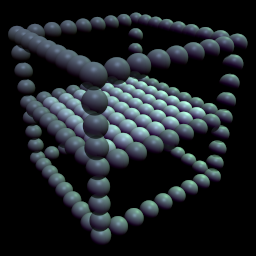
Overview
If one node moves, which nodes feel the disturbance on the next update? In the original cubic lattice of the Recursive Emergent Mechanics (REM) Framework, an interior node has six neighbours, one on either side of each coordinate axis. In the experimental diamond lattice it has four. Changing those connections while keeping the Fundamental Node Equation gives REM a way to study how the geometry of a neighbourhood shapes a travelling wave.
The name comes from the arrangement of atoms in a diamond crystal. REM borrows that geometry. A node represents a site in a mechanical model, and a bond identifies a pair of sites that can influence one another directly.
Diamond Lattice Geometry
Imagine a cube with a node at its centre. Pick four alternating corners so that no two share an edge. The directions from the centre to those corners are the four bond directions. The corners form a regular tetrahedron, so all four bonds have the same equilibrium length and every pair makes the same angle, $\arccos(-1/3) \approx 109.47^\circ$. Diamond crystals have this four-neighbour coordination. Crystallographic reference.
The diamond lattice has two interleaved sets of sites, called sublattices. Each bond connects one set to the other. If the four outward unit vectors at a site in the first set are $\mathbf e_1,\ldots,\mathbf e_4$, the four directions at a site in the second set are their negatives. At either site the four vectors add to zero. This is how a node can have a balanced neighbourhood even though none of its four bonds has an opposite partner at that node.
Fundamental Node Equation
Let $\mathbf p$ be the current position of an interior node and $\mathbf n_j$ the current position of its $j$th neighbour. With coupling parameter $k$ and no external drive, the Fundamental Node Equation gives the following restoring acceleration.
$$ \mathbf a = \frac{k^2}{4}\sum_{j=1}^{4}(\mathbf n_j-\mathbf p) = k^2(\bar{\mathbf n}-\mathbf p). $$
Here $\bar{\mathbf n}$ is the mean of the four neighbour positions. At equilibrium that mean coincides with the node, so its acceleration is zero. As a thought experiment, hold the neighbours still and move the centre a distance $d$ upward. At the next update its acceleration points downward with magnitude $k^2d$. Moving the whole neighbourhood upward together leaves every relative position, and hence the acceleration, unchanged.
Wave Propagation
Now let the neighbours move. The displaced node appears in each neighbour’s own position sum. Those neighbours acquire acceleration, their velocities change, and their new positions affect the next layer of nodes. Repeating this update carries a pulse across the lattice. A disturbance can therefore travel many bond lengths while individual nodes oscillate near their equilibrium sites.
The direction in which a node oscillates is its polarization. A source can move up and down along $z$ while receivers to its side detect a pulse travelling across the $xy$ plane. This distinction matters when placing receivers. To compare travel in different directions, place them at the same straight-line distance from the source and identify the same feature of the pulse at each receiver.
Directional Isotropy
Directional isotropy means that a measured property is independent of direction under otherwise equivalent conditions. The tetrahedron gives four equivalent bonds at each interior node. A wave travelling across many nodes samples many bonds, and its arrival time, amplitude and speed can each have a different directional dependence.
The REM v0.5.0 transverse survey (run transverse-1794261672465) used a $240^3$ diamond lattice with absorption off. For each of 26 source orientations, it sampled 16 rays perpendicular to the oscillation axis. That gave 416 complete pulse records at each of 16 radii from 40 to 85 equilibrium bond lengths. Recording finished at update 272, before the run’s conservative boundary limit of 319 updates.
Arrival was the first time the signal magnitude reached half of that receiver’s own peak, interpolated between updates. At each radius the survey calculated the directional spread as the range of arrival times divided by their mean. The spread was 1.060% at 40 bond lengths and 0.260% at 85. All 15 sampled radii from 43 through 85 were below 1%.
A weak pulse and a strong pulse can reach half of their respective peaks at nearly the same time. In this run, peak-amplitude spread ranged from 8.98% to 18.40% across the shells. Speed estimated by matching waveforms between adjacent shells had a spread of 1.25% to 2.20%. The sub-1% result therefore applies specifically to half-peak arrival timing at the stated radii, for this excitation and these sampled directions.
Mechanical Imbalance
Node acceleration answers “How will this node move on the next update?” Its input is the instantaneous vector imbalance $\bar{\mathbf n}-\mathbf p$. Locating a wave source asks a different question. A node oscillating along $z$ reverses its acceleration during a cycle even if the source stays in exactly the same place.
For the source-direction investigation, each of the four neighbouring sites can supply a three-dimensional geometric measurement. At each site the diamond diagnostic measures how much each of its own bonds has stretched or shortened from equilibrium, multiplies that signed change by the bond’s current unit direction, and sums the contributions. This gives a vector $\mathbf w_j=(w_{jx},w_{jy},w_{jz})$ for neighbour $j$. Comparing these four responses across space gives a candidate imbalance gradient. The comparison reads the motion generated by the node equation and leaves the acceleration calculation intact.
Cycle-Based Measurement
One snapshot can catch an oscillation as it passes through zero. The proposed measurement follows all three components at all four neighbours through the same complete oscillation cycle $C$, bounded by successive occurrences of the same phase at a reference receiver. One candidate statistic is the peak-to-peak range for each component $\alpha$.
$$ W_{j\alpha}=\max_{n\in C} w_{j\alpha}(n)-\min_{n\in C} w_{j\alpha}(n), \qquad \alpha\in\{x,y,z\}. $$
For a $z$-oscillating source, compare the four $z$ ranges at their known positions around the receiver. Weight each equilibrium bond direction by its neighbour’s $z$ range and project onto the $xy$ plane.
$$ \mathbf G_{xy}=\sum_{j=1}^{4} W_{jz}(e_{jx},e_{jy}). $$
Four equal ranges cancel. A larger range on one side tips the estimate towards that side. Where oscillation strength increases towards a single source, this gives a candidate bearing in the plane. Peak-to-peak reconstruction still needs validation. A direct test would place the source at a known bearing, measure angular error over successive complete cycles on both sublattices, and compare it with the error obtained using root-mean-square amplitudes. A zero vector supplies no bearing.
Pressure and Transport
In REM, an Identity is a persistent oscillator. Its Occupancy identifies the lattice node it currently occupies. Pressure is the directional imbalance accumulated by that Occupancy over time. Transport is a discrete event in which the Identity transfers its Occupancy to a connected neighbour. A pulse can pass through the lattice while an Identity stays at the same site.
A future test could hold the Occupancy at one site while a source runs on one side, then repeat with the source on the other side. Does accumulated Pressure reverse with the measured bearing? A source-off control would reveal any drift caused by the geometry or the measurement itself. A subsequent test could enable transfers and record which of the four neighbours receives the Identity when the transfer condition is met. This would test the proposed link between a cycle measurement and a transport decision.
Conclusion
Four tetrahedral connections suffice for the Fundamental Node Equation to transmit a disturbance through the experimental diamond lattice. The transverse survey gives a concrete benchmark for how closely pulse arrival times agree across directions. Can one receiver recover a known source bearing from just four neighbours over a cycle? Answering it would give the Pressure and Transport investigations a directional measurement they can test independently.
Testing first change article via ChatGPT