REM Framework
  • Home
    • Contact
    • Download
    • Featured
    • Development
      • Origin of the REM Framework
      • Roadmap
      • Changelog
  • Fundamental Principles
    • Introduction
    • Definitions
    • Axioms
    • Mathematical Structure
  • Fundamental Mechanics
    • Fundamental Node Equation
    • Recursive Node Dynamics
    • Wave Propagation
    • Identity
    • Occupancy
    • Pressure
    • Transport
    • Imbalance
    • Diamond Lattice
      • REM Framework — Publishing Workflow Test
  • Emergent Physics
    • Emergence
    • Gravity
    • Mass
    • Electricity
    • Magnetism
    • Electromagnetic Field
    • Entropy
  • Emergent Organization
    • Stable Configurations
    • Compound Identities
    • Atom-like Structures
  • Validation
    • Double-Slit Experiment
    • Stability Analysis
    • Simulation Results
    • Diamond Lattice Simulation Results: Arrival Timing and Directional Spread
Home 25 July 2026


Discrete and Continuous Foundations

One of the most fundamental questions in the development of the REM Framework is whether the universe should be described as continuous or discrete. Rather than assuming one approach is correct, it is useful to examine both and understand the assumptions behind each.

Continuous descriptions have formed the foundation of much of modern physics. Space and time are represented as smooth quantities, allowing positions and moments to take any value. The evolution of a system is typically described by differential equations that define how physical quantities change continuously.

A discrete description takes a different approach. Instead of continuous evolution, the universe is represented as a sequence of individual states. Each state contains the complete description of the system at one moment, and the next state is obtained by applying the same local rules recursively.

Both approaches are capable of producing complex and emergent behaviour. Continuous systems can generate waves, turbulence and self-organization, while discrete systems can produce equally rich behaviour through repeated local interactions. The existence of emergence alone is therefore not sufficient to justify one approach over the other.

The purpose of the REM Framework is not to claim that a discrete description must be correct, but to investigate whether a discrete recursive foundation provides a simpler and more natural explanation for the emergence of physical phenomena.


Questions Worth Investigating

  • Can every discrete model be reformulated as a continuous one?
  • Can every continuous model be reformulated as a discrete one?
  • Which description provides the simplest explanation for causality?
  • Is a discrete state easier to define than a continuously changing state?
  • Does a continuous universe require physically realized infinities, or are infinities only mathematical idealizations?
  • Is recursion fundamentally discrete, or can recursion describe continuous evolution equally well?
  • Can locality be expressed equally naturally in both descriptions?
  • Does one approach provide a clearer foundation for emergence?
  • Is computation merely a practical implementation, or does it reveal something fundamental about the structure of reality?


Current Position of the REM Framework

At present, the REM Framework adopts a discrete recursive lattice as its foundational model. This choice is motivated by the desire to describe the evolution of the universe as a sequence of complete mechanical states connected through local recursive interactions.

Whether this choice ultimately proves to be a better description of reality remains an open scientific question. One objective of the REM Framework is to investigate this possibility by exploring which physical phenomena emerge naturally from such a foundation and by comparing the results with both observation and alternative theoretical approaches.

--------------------------

This page is a collection of ideas, questions and possible directions for the future development of the REM Framework. It is not intended to present final conclusions, but to record the reasoning that led to the framework and identify the fundamental assumptions that deserve further investigation.


The Fundamental Question

Rather than asking "How can the REM Framework explain gravity?", a deeper question emerged during our discussions:

What is the simplest possible universe capable of producing everything we observe?

This question shifts the focus away from reproducing individual physical phenomena and towards identifying the minimum assumptions required for a consistent description of reality.


The Philosophy of REM

The REM Framework should not begin with conclusions. Instead, every assumption should be questioned.

For every principle we introduce, we should repeatedly ask:

  • Why is this assumption necessary?
  • Could the same phenomenon emerge without it?
  • Is there a simpler explanation?

This approach allows the framework to evolve naturally while minimizing unnecessary assumptions.


The Motivation Behind REM

The REM Framework did not begin with the goal of building a discrete universe.

Instead, it began with a simple question about motion.

How can an object move from one location to another if it must pass through infinitely many intermediate positions?

Although calculus provides a mathematical solution through convergent infinite series, the question remained whether physical reality itself requires infinitely many intermediate positions.

This question eventually led to investigating a finite, recursive and discrete description of nature.


Zeno's Question

More than two thousand years ago, Zeno asked how motion is possible if an object must first travel half the remaining distance, then half again, continuing indefinitely.

Modern mathematics resolves this using convergent infinite series.

The REM Framework investigates a different possibility:

Can motion be represented as a finite sequence of recursive state transitions instead of infinitely many intermediate positions?

The purpose is not to reject continuous mathematics, but to investigate whether physically realized infinities are necessary.


Continuous and Discrete Foundations

Continuous mathematics has been extraordinarily successful in describing nature.

The REM Framework does not dispute this success.

Instead, it asks another question:

Can a finite, discrete ontology reproduce the same observable phenomena that are traditionally described using continuous mathematics?

If so, discreteness could provide an alternative foundation while preserving the observable predictions.


Mathematics versus Physical Reality

An important distinction should be made between mathematical descriptions and physical ontology.

Continuous mathematics may provide an accurate language for describing nature without necessarily implying that physical reality itself is continuous.

The REM Framework therefore asks:

  • Does successful mathematics determine physical reality?
  • Or can different ontologies produce identical observable behaviour?


Emergence

One of the long-term objectives of the REM Framework is to investigate whether increasingly complex phenomena can emerge from simple local rules.

Possible stages include:

  • Recursive node dynamics
  • Wave propagation
  • Pressure
  • Transport
  • Mass
  • Gravity
  • Charge
  • Magnetism
  • Atoms
  • More complex structures

This naturally leads to one of the most fundamental questions:

Can the elementary constituents themselves emerge from an even simpler mechanical rule?


Questions Worth Investigating

Space

  • Is space fundamental?
  • Can space emerge?
  • Is space discrete?
  • Can continuity emerge from discreteness?

Time

  • Is time fundamental?
  • Is a recursive update equivalent to a moment?
  • Does time emerge from ordered state transitions?

Motion

  • What is motion?
  • Does motion require continuous trajectories?
  • Can motion be represented solely by changing occupancy?

Information

  • Is information fundamental?
  • Does nature require infinite information?
  • Can finite information completely describe physical reality?

Locality

  • Why locality?
  • Can non-local behaviour emerge from purely local interactions?
  • What is the minimum definition of locality?

Medium

  • Is a propagation medium necessary?
  • What properties must such a medium possess?
  • Is the lattice fundamental, or merely one possible representation?

Symmetry

  • Can continuous symmetry emerge from a discrete lattice?
  • Can isotropy emerge at large scales?

Scale

  • Does continuity emerge naturally when observing sufficiently large scales?
  • Is continuity simply an approximation of discrete mechanics?


Working Principle

Every assumption introduced into the REM Framework should answer a simple question:

Why is this assumption necessary?

If the answer raises another question, the process should continue until no deeper explanation is available.

The objective is to construct the framework from the smallest possible set of assumptions.


Closing Thought

Perhaps the central objective of the REM Framework can be summarized by two questions:

What assumptions are truly necessary to describe reality?

What is the simplest possible universe capable of producing everything we observe?

These questions do not assume that the universe is discrete, continuous, mechanical or otherwise. Instead, they provide a starting point for investigating the most fundamental principles from which physical reality may emerge.


Future Research Directions

Identity

Can an Identity occupy multiple nodes?

Can an Identity have internal recursive dynamics?

Can Identity size emerge?

Can Identity shape emerge?

Can multiple oscillation modes coexist?

Can an Identity divide or merge?

Is the current one-node Identity merely the simplest approximation?


Compound Identities (Working Hypothesis):

Investigate whether larger persistent structures can emerge through stable relationships between multiple simple Identities rather than by extending the definition of a single Identity. The current hypothesis is that complexity should arise from organization, not from increasing the complexity of the fundamental building block.
Home 21 January 2023


  ​​You can download the application at:
https://github.com/dqnguyen59/QuantumFieldSimulator/releases

Or download Java source code at:
https://github.com/dqnguyen59/QuantumFieldSimulator

​Recommended graphics cards:
NVIDIA RTX2080Ti, AMD Radeon RX6800 or higher.


Home 20 January 2023


Welcome to Smart Black Box

Quantum Field Theory (QFT) or is it just a simulation theory? Whether you call it a quantum field theory or a simulation theory, both do calculations based on mathematics. The existence of the universe and where we come from has amazed me for years. Now that there are more ideas from people around the world, the idea of what reality is has evolved in an interesting way. So many ideas you've never thought of before. Even among people around the world with no scientific or philosophical background, they have ideas about reality and even parallel realities. As many have thought, we already live in an illusionary reality or a simulation. But this illusion feels very real to me.


Einstein once said:

“Reality is merely an illusion, albeit a very persistent one.”


This quote got my brain cells working really hard. If reality is an illusion, then the universe must be an imagination. I'm not sure if this statement is true, but it feels right to me.

So I started this quest for what we are really made of. It is actually not wrong to say that we live in an illusionary world. Maybe we live in a computer simulation that is so good we don't even notice it. But the paradox is that the computer that simulates this reality must be made of 'something'. So what is this 'something' made of, a simulation in a simulation and you can go on forever. Scientists are beginning to believe that consciousness has something to do with this. Such as an observation that affects the outcome of the double slit experiment. But consciousness is a problem for scientists, because how do you measure consciousness? Let alone what is consciousness? This is another topic that I won't go into in depth because I want to talk about how reality is likely constructed and simulated. The simulator I have been working on since mid-2022 is just an approximation of how I think about how reality works. It is far from complete, but it is a start.


But there's also the aether theory, which has been criticized by many scientists and replaced by the quantum field theory, but I think there are some elements in both theories that make sense. The aether theory states that the medium must be a continuous space that carries the electromagnetic waves. And this medium is made of an invisible substance or field that is beyond our reach.


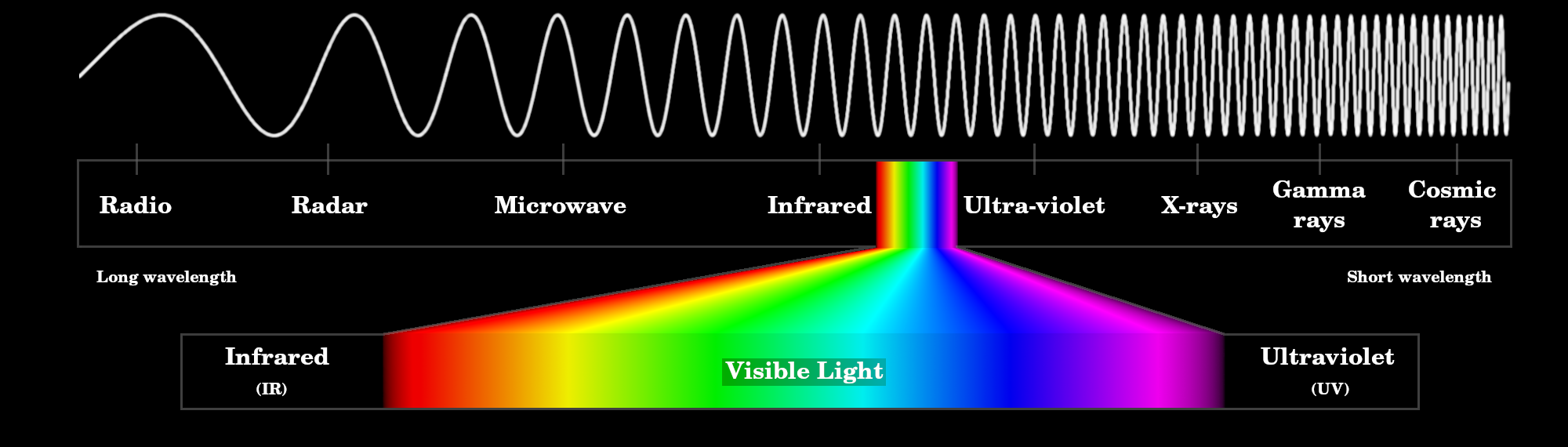
The proposed field is the carrier of electromagnetic waves, see above the entire electromagnetic spectrum.


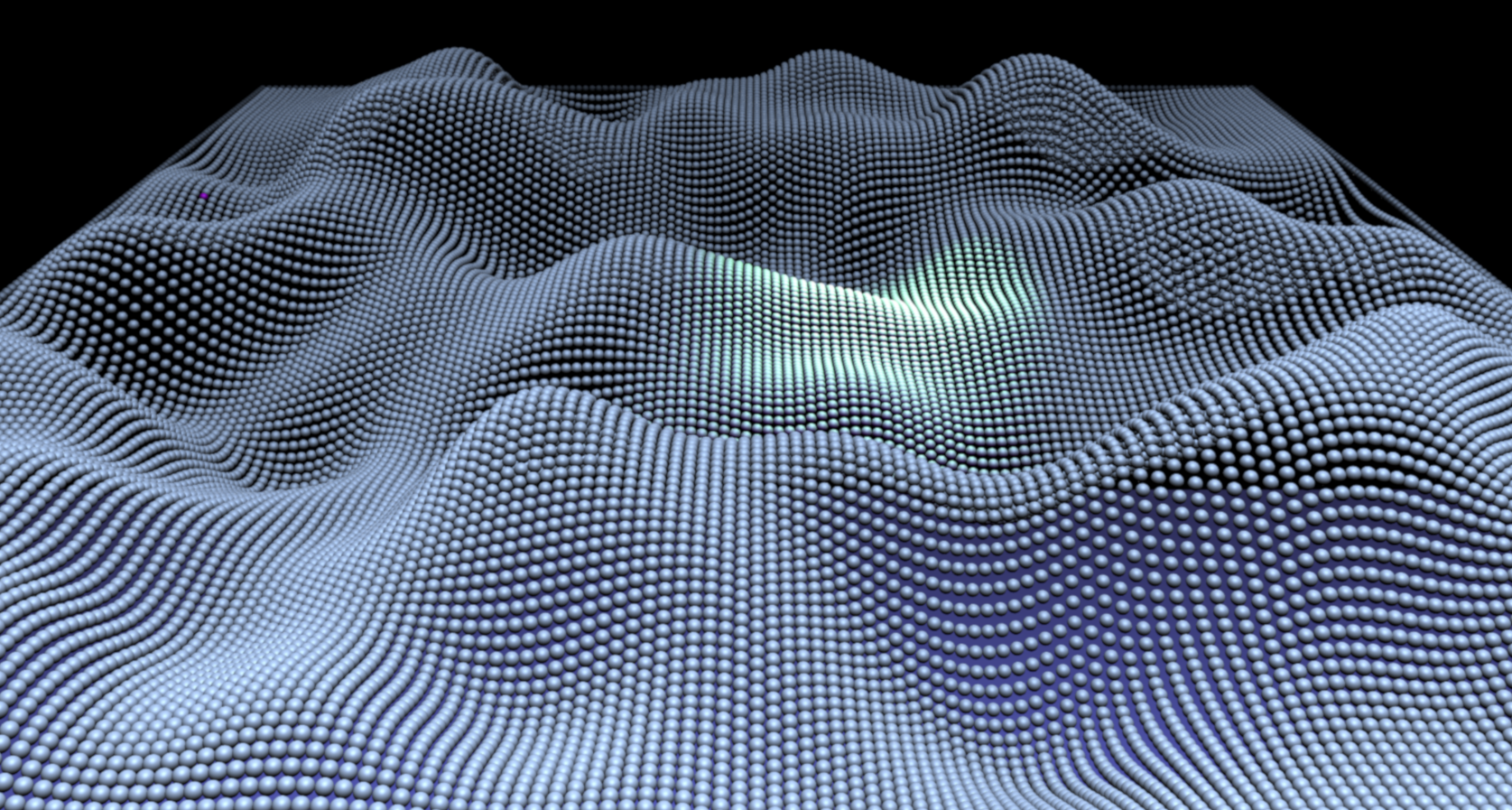
I agree with the idea of an invisible substance or a field, but I have to disagree with the idea of a continuous space. Because a continuous space might work with mathematical equations, but in practice it doesn't make any sense at all. Because infinity large or infinity small is impossible to compute. The concept of infinity has amazed me for years, but I have to come to the conclusion that this is not always practical. The QFT, on the other hand, is more practical. But I can't follow the proposed equations that can be found on the internet, because this is way over my head. The idea of the quantum field is represented as a discrete space and consists of mass points connected by a spring. The distance between the points is known. Each point interacts with its neighbors to determine its location in space and therefore creates a wave that propagates through space. This is a very interesting idea.

{mp4}QuantumFieldLoop{/mp4}

So the QFT doesn't actually describe what the field is made of, but rather a concept of what it could be. Can we then say that both aether and QFT say that the field is made of an invisible substance or an imaginary substance? What I believe is that this substance is invisible to us from our perspective as a human that lives in a 3D world. But from the creator's point of view, seen from beyond our 3D reality, this field can be perceived. But the question is: "if there is a creator, then who creates the creator of our reality?". I know, some would say: "it's some guy sitting behind his computer, presses some buttons and he is playing a game!". I do have some idea about this paradox, but that requires a more detailed explanation and for now QFT is already difficult enough.

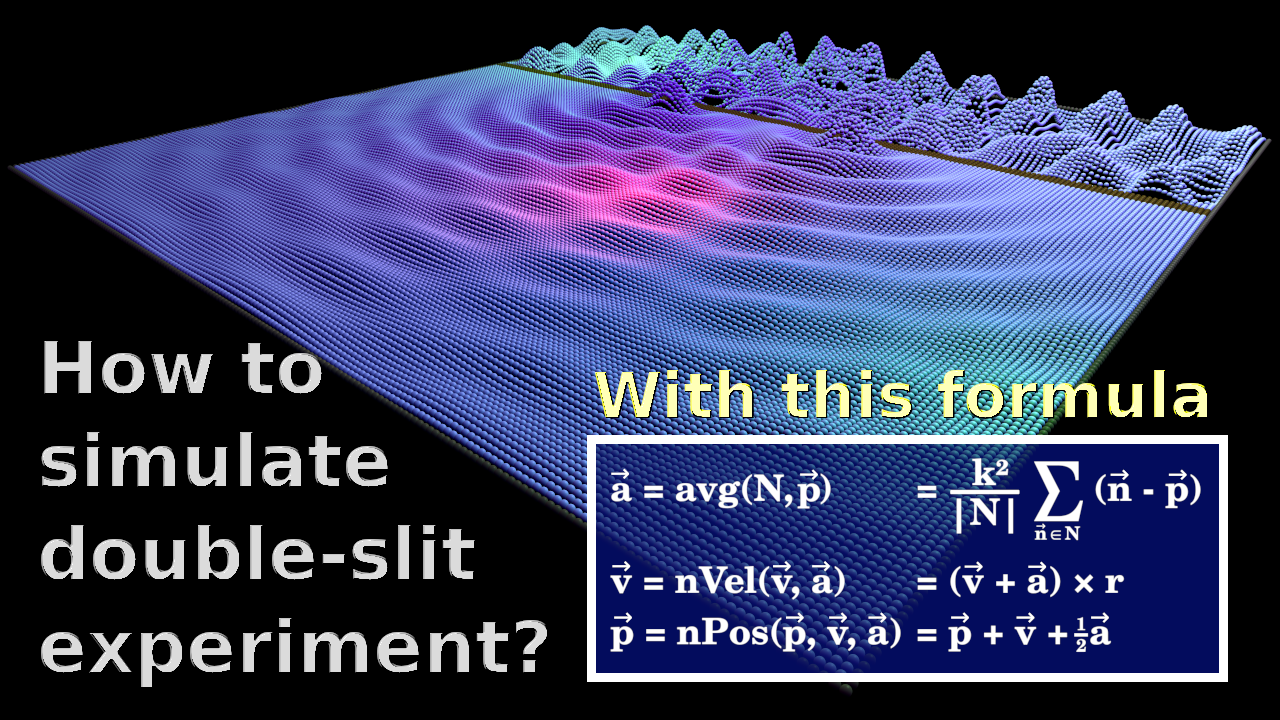
To simulate this field, one could use the proposed point of masses and springs in a 3D matrix. You could do this with complex formula's, but what if this can be simulated with a very simple formula. And I think I may have found a way to simulate this. I have discovered this formula by trial and error. The application and source code can be downloaded on my Github page. This application was initially developed to simulate the double-slit experiment to see if it can be done with this theory.


​​You can download the application at:
https://github.com/dqnguyen59/QuantumFieldSimulator/releases

Or download Java source code at:
https://github.com/dqnguyen59/QuantumFieldSimulator

​Recommended graphics cards:
NVIDIA RTX2080Ti, AMD Radeon RX6800 or higher.

​Watch video tutorial on YouTube:YouTube Logo


The Quantum Field Formula

{mp4}QuantumFieldOscillator{/mp4}

Before we talk about the formula, first we have to ask the following questions. How is the field constructed? And what are the rules to make it work?

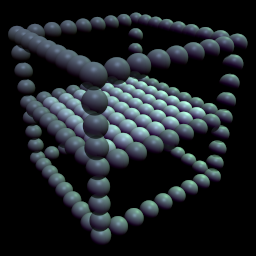
​​I believe that the field consists of a substance, which I call "a field of nodes", where each node has a number of properties that follow the rules of the laws of motion as we know them in physics. These properties are location, acceleration and velocity. The nodes are placed in a matrix form, where each node is connected to its neighbors. Each node can only have 6 neighbors, right, up, front, left, down and back. It takes energy to change a node's position and just like when a node changes position, it will distribute its energy evenly among its neighbors. And because of this effect it will cause a wave. The distance between the nodes must be the smallest ever, but not infinitely small. To give you an idea of how small this is, there are billions, billions, billions and billions of nodes that fit in the diameter of a hydrogen atom. How many nodes to be exact? See calculation below:


$\text{Planck length: } {1.616255} \times {10}^{-35} m$

$\text{Hydrogen atom}: {1.06} \times {10}^{-10} m$

$\text{Nodes } = \frac{Hydrogen atom} {Planck length} = \frac {{1.06} \times {10}^{-10}} {{1.616255} \times {10}^{-35}}$

$\text{Nodes } = {6.558}×{10}^{24}$ (6558000000000000000000000)


These smallest units (length, time, mass and temperature) have been postulated by Max Planck.

The video above is an example of what the field looks like when only one node oscillates in the center, say in a circular motion. The central node gives its energy to its neighbors and the neighbors also give its energy to its neighbors, and so on.


\begin{array}{rcl}
\Large \text{Quantum Field Formula}
\end{array}

\begin{array}{rcl}
\vec{a} & = & \text{node acceleration} \\
\vec{v} & = & \text{node velocity} \\
\vec{p} & = & \text{node position} \\
N & = & \text{neighbor node position} \\
  &   & \left\{ N \in \mathbb{R}^n \hspace{0.15cm}|\hspace{0.15cm} \tiny Right, Up, Front, Left, Down, Back \normalsize \right\} \\
r & = & \text{constant radiation} \\
  &   & \left\{ r \in \mathbb{R} \right\} \\
k & = & \text{constant wave speed} \\
  &   & \left\{ k \in \mathbb{R} \text{ | } 0 \ge k \le 1 \right\} \\
  &   & \\
\vec{a} & = & avg\small{(N, \vec{p})}\normalsize \\
avg\small{(N, \vec{p})}\normalsize & = & \Large \frac {k^2} {\left| N \right|} \sum \limits_{\vec{n} \in N} {\vec{n} - \vec{p}} \\
        &   & \\
\vec{v} & = & nVel\small{(\vec{v},\vec{a})}\normalsize \\
nVel\small{(\vec{v},\vec{a})}\normalsize & = & \Large \left( {\vec{v}} + {\vec{a}} \right) {r} \\
        &   & \\
\vec{p} & = & nPos\small{(\vec{p},\vec{v},\vec{a})}\normalsize \\
nPos\small{(\vec{p},\vec{v},\vec{a})}\normalsize & = & \Large {\vec{p}} + {\vec{v}} + \frac {1} {2} {\vec{a}} \\
\end{array}


​This is the formula (above) I discovered through trial and error. ​A very simple formula, without using any complicated math. For each node acceleration is calculated first. The new velocity is calculated with acceleration and its previous velocity as inputs. And the new position is calculated with acceleration, velocity and its previous position as inputs. ​This formula is actually derived from the physics formula of motion below.


\begin{array}{rcl}
\Large \text{Motion Formula}
\end{array}

\begin{array}{rcl}
a & = & \text{acceleration} \\
v_{\tiny 0} & = & \text{initial velocity} \\
v & = & \text{velocity} \\
x_{\tiny 0} & = & \text{initial position} \\
x & = & \text{position} \\
t & = & \text{time} \\
  &   &   \\
v & = & v_{\tiny 0} + a \times t \\
  &   &   \\
x & = & x_{\tiny 0} + v_{\tiny 0} \times t + {\frac{1}2} a \times t^2 \\
\end{array}


The calculation for the velocity and position are different, because time (t) is missing in my formula. ​There's a very good reason for that. ​Since we are working with Planck units, then we can say that one Planck-time is one frame and one Planck-length is the distance between the nodes. ​Which means t can be considered as 1, so t can be eliminated from the formula. ​The reason why the formula works is because of the calculation of acceleration. ​​The acceleration is calculated by averaging the distance of the node and its neighbors. ​​The calculated speed and position will be used when the next frame is calculated. ​​This way, each node updates its properties with each frame, and by executing these frames in quick succession, you see a wavy animation of the field. ​​Since each node is affected by the changes of its neighbors, it will create a rippling effect through space. ​The speed of the ripple can then be calculated. ​This ripple is similar to electromagnetic waves and so the speed of the ripple can also be compared to the speed of light. The constant k determines the speed of the ripple or the speed of light. This constant can be set between 0.0 and 1.0 and the lower the value the lower the speed. But also, the lower the value the higher the amplitude it will have. ​The radiation (r) is optional and will cause the wave to fade or even amplify. The constant r is by default 1.0. If this value is less than 1.0, then the wave will fade. And if the value is greater then 1.0, then the wave will amplify. ​​​​But amplifying the wave makes no sense at all, because it makes the wave infinitely large. ​​During the development of the application, the wave seems to fade, while the radiation is set to 1.0. ​This was tested when the wave was initiated once and since the wave is always contained in a box (with reflection), you would expect the wave to continue indefinitely. ​This may have been caused by the use of the Double data type. ​This data type has a length of 32 bits and an accuracy of 4.9E-324. But this imperfection can be compensated by empirically finding a radiation slightly higher than 1.0. Perhaps using integers would be a better choice as it eliminates these accuracy errors. The nodes do not actually move through space to an arbitrary position which may be very far away, but only oscillate within their limited area using their fixed location as a base. It is the nature of the interactions between the nodes that creates a wave through the field of nodes, or in other words through space.


{mp4}QuantumFieldDoubleSlitLoop{/mp4}


Video tutorial: How to simulate a double-slit experiment?


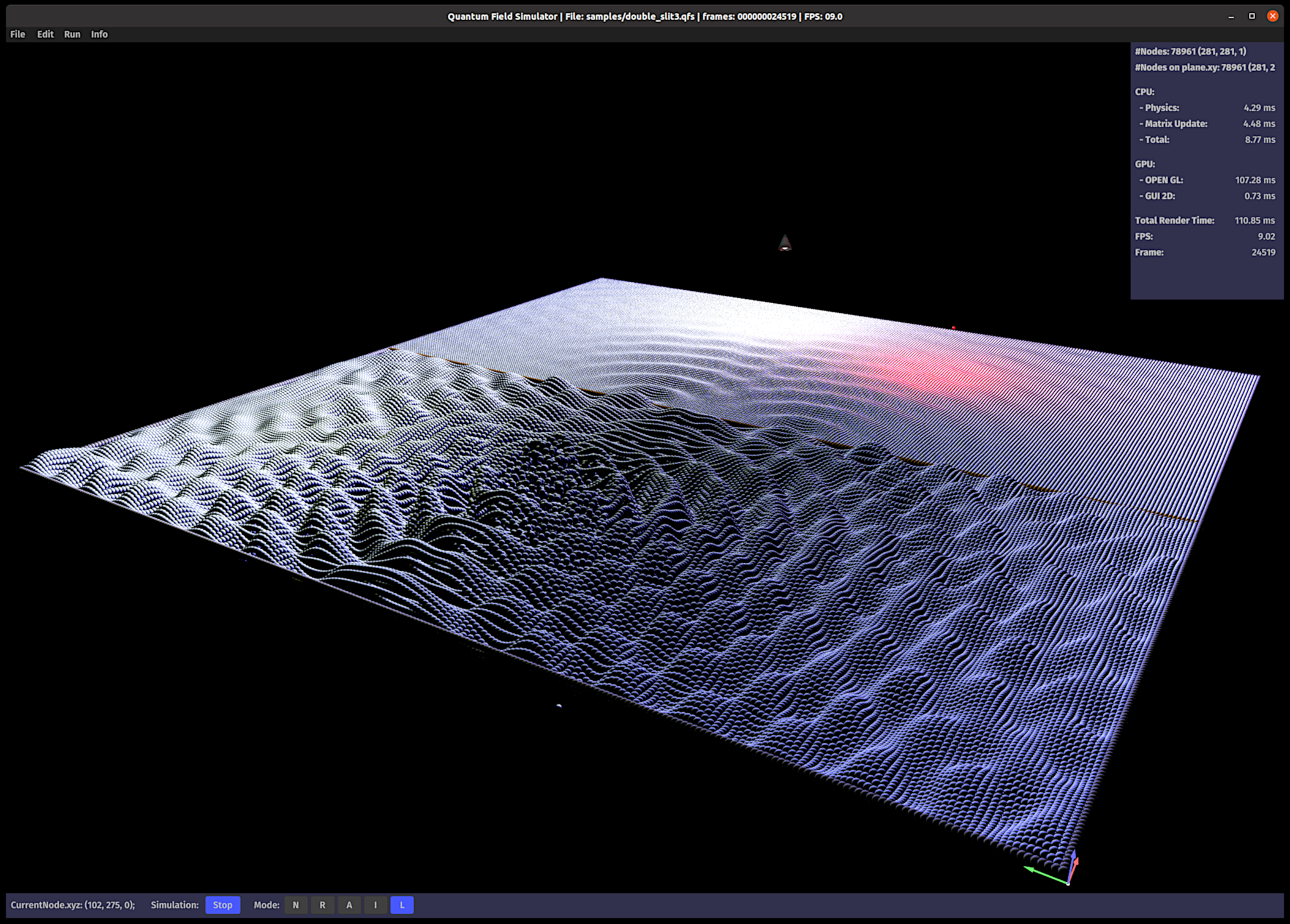
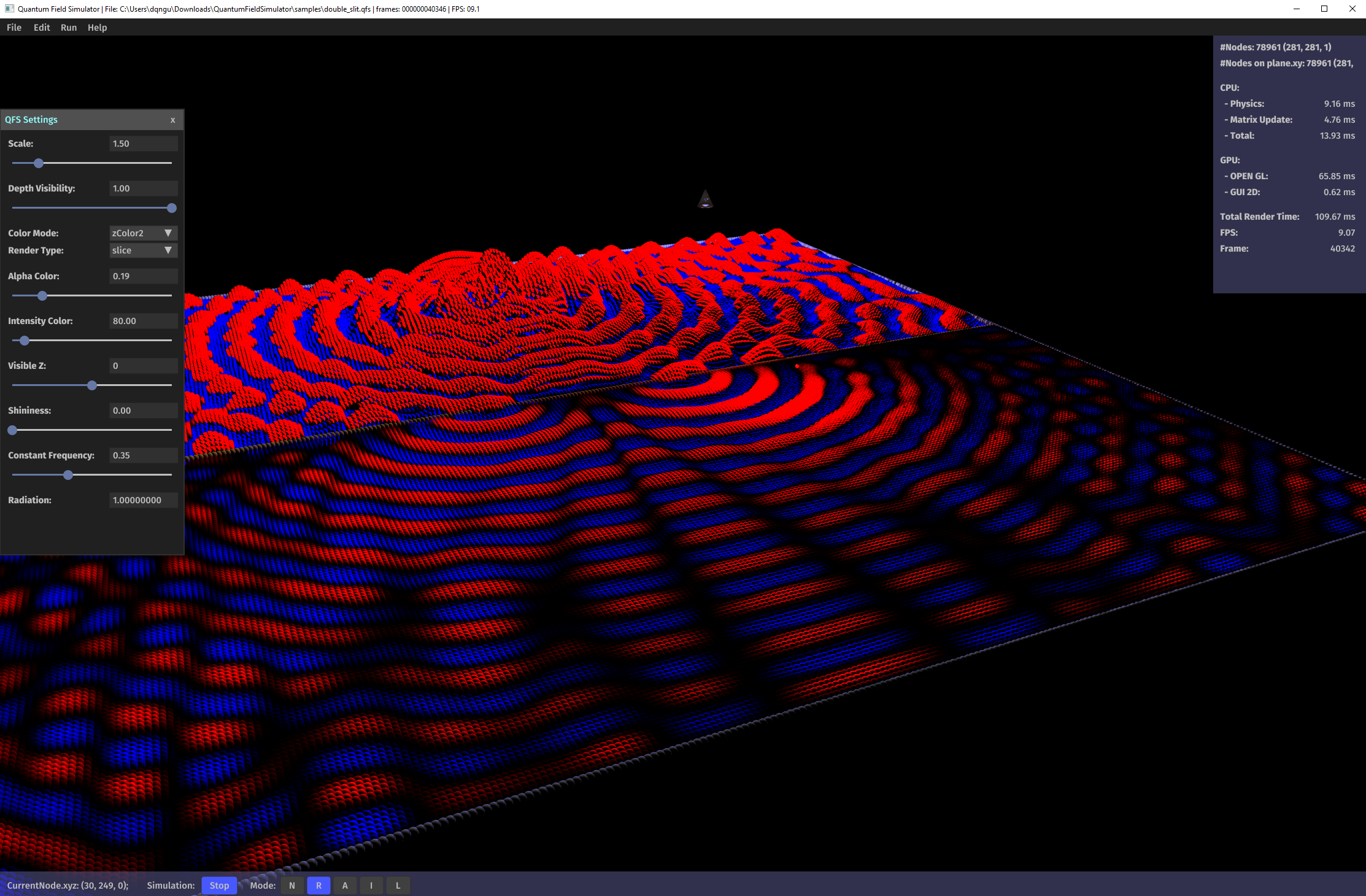
The application is capable of creating walls. ​A wall contains nodes that are fixed and therefore immovable. Such nodes cannot be affected by other nodes. ​​However, a fixed node affects other nodes that are not fixed. ​A node that is near a fixed node will have more difficulty changing its position than a node that is further away from a fixed node. ​Walls are like mirrors and reflect the wave that hits them, which can be seen in the simulation. ​If you make one slit in the wall, you can clearly see how the energy is dispersed at the opening of the slit. ​​If you make a double slit in the wall, you will clearly see an interference pattern like the picture above.​ The interference pattern occurred when the waves cancel each other out.​​

Although the formula I discovered with this simulation differs from the formula proposed in quantum field theory, I am surprised to see how this simple formula works so gracefully. ​​But I'm sure there is much more to discover, perhaps how an atom is constructed. ​The formula I discovered is far from complete, but I hope to find more in the future. ​​I'm amazed that the motion formula works just as well in the small-scale as Planck units as it does in our daily lives when we drive to work in our car.


Home 02 February 2022

Smart Black Box

E-mail: This email address is being protected from spambots. You need JavaScript enabled to view it.


© 2026 REM Framework
  • Home
    • Contact
    • Download
    • Featured
    • Development
      • Origin of the REM Framework
      • Roadmap
      • Changelog
  • Fundamental Principles
    • Introduction
    • Definitions
    • Axioms
    • Mathematical Structure
  • Fundamental Mechanics
    • Fundamental Node Equation
    • Recursive Node Dynamics
    • Wave Propagation
    • Identity
    • Occupancy
    • Pressure
    • Transport
    • Imbalance
    • Diamond Lattice
      • REM Framework — Publishing Workflow Test
  • Emergent Physics
    • Emergence
    • Gravity
    • Mass
    • Electricity
    • Magnetism
    • Electromagnetic Field
    • Entropy
  • Emergent Organization
    • Stable Configurations
    • Compound Identities
    • Atom-like Structures
  • Validation
    • Double-Slit Experiment
    • Stability Analysis
    • Simulation Results
    • Diamond Lattice Simulation Results: Arrival Timing and Directional Spread